08. 控制门#
下面介绍一个例子——控制Z门(CZ门):
from mindquantum.core.gates import Z
from mindquantum.core.circuit import Circuit

circ = Circuit()
circ += Z.on(1, 0)
circ.svg()
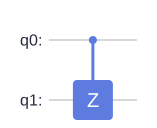
这个门的作用是:
当控制比特q0为1时,对目标比特q1作用Z门;
当控制比特q0为0时,不做任何操作;
也就是说:
写成矩阵形式:
CZ门具有一个性质,交换控制比特和目标比特后,作用效果不变。
from mindquantum.core.gates import Z
from mindquantum.core.circuit import Circuit
from IPython.display import display_svg
import numpy as np

circ1 = Circuit()
circ1 += Z.on(1, 0)
display_svg(circ1.svg())

circ2 = Circuit()
circ2 += Z.on(0, 1)
display_svg(circ2.svg())

print(np.allclose(circ1.matrix(), circ2.matrix()))
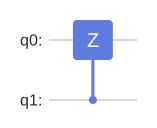
True
我们可以使用 CZ 门和 Hadamard 门来实现 CNOT 门。
from mindquantum.core.gates import Z, H, CNOT
from mindquantum.core.circuit import Circuit
from IPython.display import display_svg
import numpy as np

circ1 = Circuit()
circ1 += H.on(0)
circ1 += Z.on(1, 0)
circ1 += H.on(0)
display_svg(circ1.svg())

circ2 = Circuit()
circ2 += CNOT.on(0, 1)
display_svg(circ2.svg())

print(np.allclose(circ1.matrix(), circ2.matrix()))
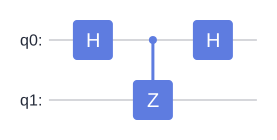
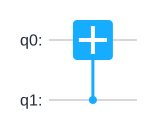
True
控制U门#
CZ门是一种特殊的 \(C(U)\) 门,其中 \(U = Z\)。一般来说,\(C(U)\) 门的定义为:
控制比特为1时,对目标比特作用 \(U\) 门;
控制比特为0时,不作用(作用 \(I\) 门);
相位#
考虑一种简单情形 \(U = e^{i\alpha}I\)。
如果仅仅是单量子比特,那么 \(e^{i\alpha}\) 作为全局相位,我们可以忽略它(全局相位在物理上没有观测效应)。
如果是 \(C(U)\) 二量子比特门,此时就不能忽略掉 \(e^{i\alpha}\)。不妨设 \(|q_1 q_0\rangle\),控制比特是 q0:
对于一般的 \(|\psi\rangle = a |00\rangle + b |01\rangle + c|10\rangle + d|11\rangle\),作用效果为:
因此 \(C(e^{i\alpha}I)\) 等价于一个单量子比特门。
from mindquantum.core.circuit import Circuit
from mindquantum.core.gates import UnivMathGate, I
from IPython.display import display_svg
import numpy as np
from numpy.random import rand

alpha = rand()
print(f"alpha = {alpha}")

u = UnivMathGate("U", np.array(
    [[np.exp(complex(0, alpha)), 0],
     [0, np.exp(complex(0, alpha))]]))
circ1 = Circuit()
circ1 += u.on(1, 0)
display_svg(circ1.svg())

p = UnivMathGate("U'", np.array(
    [[1, 0],
     [0, np.exp(complex(0, alpha))]]
))
circ2 = Circuit()
circ2 += p.on(0)
circ2 += I.on(1)
display_svg(circ2.svg())

print(np.allclose(circ1.matrix(), circ2.matrix()))
alpha = 0.9496466347941014
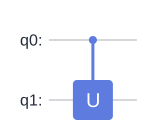
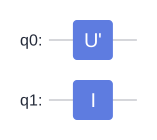
True
API 解释:
UnivMathGate(name, mat)通过矩阵mat声名一个名为name的量子门。
实现 C(U)#
根据 lecture7 我们知道 \(U = e^{i\alpha}AXBXC\),其中 \(ABC = I\)。这意味着我们可以用如下的电路实现 \(C(U)\) :
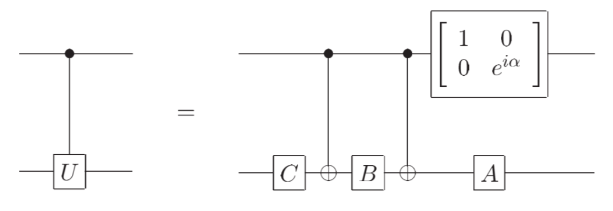
下面我们证明这件事情:
不妨设 控制比特 \(q_0 = a|0\rangle + b|1\rangle\),目标比特 \(q_1 = |t\rangle\) 。
左边的线路作用的结果为:
右边的线路一步步的作用结果:
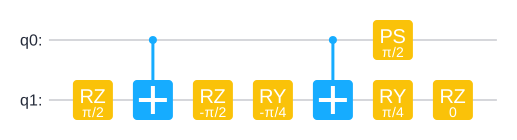
下面对 \(C(H)\) 门进行验证。
因为 \(H = e^{i\pi\over 2}R_z(0)R_y({\pi\over 2})R_z(\pi)\),所以令
from mindquantum.core.circuit import Circuit
from mindquantum.core.gates import RZ, RY, RZ, X, H, CNOT
from mindquantum.core.gates import PhaseShift
from IPython.display import display_svg
import numpy as np
from numpy.random import rand

alpha = np.pi / 2
beta = 0
gamma = np.pi / 2
delta = np.pi

circ1 = Circuit()
circ1 += H.on(1, 0)
display_svg(circ1.svg())

# A = RZ(beta) * RY(gamma / 2)
# B = RY(-gamma / 2) * RZ(-(delta + beta) / 2)
# C = RZ((delta - beta) / 2)
circ2 = Circuit()
circ2 += RZ((delta-beta)/2).on(1)
circ2 += CNOT.on(1, 0)
circ2 += RZ(-(delta + beta)/2).on(1)
circ2 += RY(-gamma / 2).on(1)
circ2 += CNOT.on(1, 0)
circ2 += RY(gamma / 2).on(1)
circ2 += RZ(beta).on(1)
circ2 += PhaseShift(alpha).on(0)
display_svg(circ2.svg())

print(np.allclose(circ1.matrix(), circ2.matrix()))
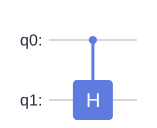
True
拓展的控制门#
下面介绍一些常用的记号,用来拓展控制门的功能。
我们使用“实心圆”表示控制比特为“1”时作用,使用“空心圆”表示控制比特为“0”时作用:
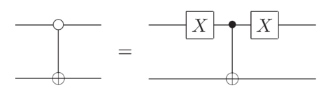
两个线路是等价的,因为
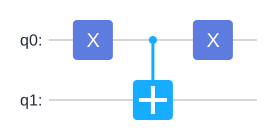
使用 MindQuantum 验证:
from mindquantum.core.circuit import Circuit
from mindquantum.core.gates import X, CNOT, UnivMathGate
import numpy as np

U = UnivMathGate("U", np.array(
    [[0, 0, 1, 0],
     [0, 1, 0, 0],
     [1, 0, 0, 0],
     [0, 0, 0, 1]]
))
circ1 = Circuit()
circ1 += U.on([0, 1])

circ2 = Circuit()
circ2 += X.on(0)
circ2 += CNOT.on(1, 0)
circ2 += X.on(0)
print(np.allclose(circ1.matrix(), circ2.matrix()))
circ2.svg()
True
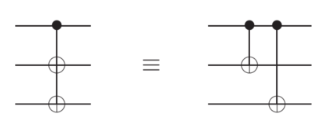
我们也可以有多个目标比特,等价于多个单目标比特的作用。
多控制比特#
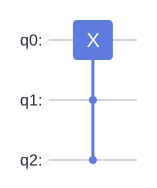
如果控制比特数目为 \(n\) 个,记作 \(C^n(U)\),作用效果如下:
当且仅当 \(x_1 = x_2 = \cdots = x_n = 1\) 时,对目标比特作用 \(U\) 操作。
from mindquantum.core.circuit import Circuit
from mindquantum.core.gates import X

circ = Circuit([X.on(0, [1, 2])])
print(circ.matrix())
circ.svg()
[[1.+0.j 0.+0.j 0.+0.j 0.+0.j 0.+0.j 0.+0.j 0.+0.j 0.+0.j]
 [0.+0.j 1.+0.j 0.+0.j 0.+0.j 0.+0.j 0.+0.j 0.+0.j 0.+0.j]
 [0.+0.j 0.+0.j 1.+0.j 0.+0.j 0.+0.j 0.+0.j 0.+0.j 0.+0.j]
 [0.+0.j 0.+0.j 0.+0.j 1.+0.j 0.+0.j 0.+0.j 0.+0.j 0.+0.j]
 [0.+0.j 0.+0.j 0.+0.j 0.+0.j 1.+0.j 0.+0.j 0.+0.j 0.+0.j]
 [0.+0.j 0.+0.j 0.+0.j 0.+0.j 0.+0.j 1.+0.j 0.+0.j 0.+0.j]
 [0.+0.j 0.+0.j 0.+0.j 0.+0.j 0.+0.j 0.+0.j 0.+0.j 1.+0.j]
 [0.+0.j 0.+0.j 0.+0.j 0.+0.j 0.+0.j 0.+0.j 1.+0.j 0.+0.j]]
from show_info import InfoTable

InfoTable('mindquantum', 'numpy')
| Software | Version |
|---|---|
| mindquantum | 0.11.0 |
| numpy | 1.26.4 |
| System | Info |
| Python | 3.11.10 |
| OS | Darwin arm64 |
| Memory | 17.18 GB |
| CPU Max Thread | 10 |
| Date | Tue Sep 16 18:00:48 2025 |
习题#
Exercise 1#
使用 H 门来实现 交换 CNOT 门的控制比特和目标比特。
Exercise 2#
使用 CNOT 和 单量子比特门 来构造 \(R_y(\theta)\) 。